Today's Runes for Denise Richards
| The Diamond spread reveals the dynamic forces at work in a situation. It is the spread of choice for understanding a hidden conflict. Stone Runes are most commonly used for questions about the natural world and things beyond human control. |
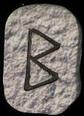
| The bottom rune represents the foundation that forms the basis of the issue. Berkana represents the birch tree. The birch is frequently symbolic of renewal, rebirth, birth, growth and fertility. This rune is a joyous one, representing good outcomes from ventures undertaken. It is the rune of the family and of a good household. |
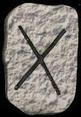
| The left rune represents one of the forces acting on the issue at hand. Gebo means gift, and like many gifts, the rune may be understood on many levels. Gifts are generally positive things, for both the giver and the recipient. In many cultures however, gifts and favors carry with them an obligation to respond in kind. It is for this reason that gifts, and hence the rune Gebo, are frequently symbolic of friendships, marriages, alliances, mergers, and other bonds between people or organizations. Gebo is a strong rune and the unions represented are strong as well. Moreover, Gebo is not reversible, as true friendships are not easily undone. |
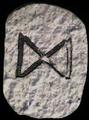
| The right rune represents another of the forces acting on the issue at hand. Dagez means daylight, and represents divine light. This rune generally refers to dawn (the initial sparking of energy) or to midday (the climax of energy). Both dawn and midday are symbolic of change, but unlike the changes in the perpetual circle of the year which are slow and subtle, the changes over a day are much faster and more dramatic. The breaking of a new day is symbolic of the rapid illumination of dismal circumstances, and is suggestive of Satori. Be careful - although this rune generally suggests a positive change, the symbology of a peaking point suggests that there must be a change downward as well. Fortunately for some, this rune is cyclic and irreversible, and so permanence is not promised - the only thing you can be sure of is an exciting ride. |
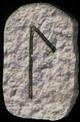
| The top rune represents the conclusion to which your strivings can carry you. Laguz is the most strongly feminine of runes, representing water. Deep sexuality is suggested by this rune. Through Laguz, water is seen as the ocean - vast, uncontrollable, ever-changing, and vital. When interpreted as the returning tide, Laguz can also predict the inevitable return from a long journey. |
|
|