Today's Runes for Jon Stewart
| The Cross spread is used to plot the arc of your life and the forces acting on it. It is the most popular spread, giving a very complete view of the situation. Spirit Runes are most commonly used for questions about mysticism, spirituality, and religion. |
| The left rune represents an important element of the past. Eoh refers to the Yew tree. The Yew does not go dormant and therefore represents endurance. Even the wood of the tree is strong, resilient, and pliable - the Yew bends, but does not break. The evergreen nature of the Yew is present even in the rune itself, as it cannot be changed even by reversal. This rune is historically symbolic of death, but, as in the Tarot and as suggested by the nature of the Yew tree itself, death is seen only as a transmutation of something eternal and unchanging - the spirit. |
| The middle rune represents a deciding element of the present. Berkana, the birch tree, is representative of rebirth, fertility, and a positive outcome to ventures undertaken. It is also the rune of families. Here the rune is reversed, warning you to be heedful of new beginnings, lest they sour. Rebirth is either delayed, or totally disrupted. There is also a warning of family troubles. |
| The top rune represents a force that works for you. Fehu is the rune of cattle, the symbol of wealth in the old Norse civilization. Since Fehu is the first rune in Frey's aett, it is a rune of fertility as well. As seen here reversed, it can represent barrenness or the loss of wealth. Some interpret Fehu as representing children, in which case the reversal may portend the distancing of a child from her or his parents. |
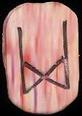
| The bottom Rune represents a force that works against you. Hagalaz is the rune of hail. Hail is a destructive and elemental force, so one can expect this rune to represent the disruption of one's life. In the harsh northern winter there is a halt to activity, and so delay or hindrance is frequently associated with this rune. The opposite of chaos is yet more chaos, as illustrated by the fact that this rune cannot be reversed. |
| The right rune represents the critical element of the future, at the core of the final outcome. Wunjo is the rune of joy. The reversal of this rune suggests that joy is withheld. Since joy is frequently communal, this rune often suggests loneliness. Alternatively, some have seen Wunjo as the rune of perfection and the rune of the gods. Therefore this rune reversed could signal a feeling of separation from one's deity, or as imperfection in an important work. |
|
|