Today's Runes for Sarah Silverman
| The Cross spread is used to plot the arc of your life and the forces acting on it. It is the most popular spread, giving a very complete view of the situation. Stone Runes are most commonly used for questions about the natural world and things beyond human control. |
| The left rune represents an important element of the past. Ehwaz is representative of the eight-legged horse ridden by the god Odin. As such, this is the rune of controlled movement and travel, including the pursuit of an objective or station in life. Since some older sources show Odin not as a man riding a horse but as a centaur-like being, this rune can also represent the union of man and nature, or the fusion of two entities in perfect harmony. As this rune is reversed, this could bode poorly for travel or for the vehicle involved. In the more spiritual sense, this rune could represent difficulties in self-improvement or other attempts at advancement. Finally, it may represent a splitting of two or the inability of two to act as one. |
| The middle rune represents a deciding element of the present. Berkana represents the birch tree. The birch is frequently symbolic of renewal, rebirth, birth, growth and fertility. This rune is a joyous one, representing good outcomes from ventures undertaken. It is the rune of the family and of a good household. |
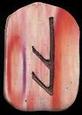
| The top rune represents a force that works for you. Eoh refers to the Yew tree. The Yew does not go dormant and therefore represents endurance. Even the wood of the tree is strong, resilient, and pliable - the Yew bends, but does not break. The evergreen nature of the Yew is present even in the rune itself, as it cannot be changed even by reversal. This rune is historically symbolic of death, but, as in the Tarot and as suggested by the nature of the Yew tree itself, death is seen only as a transmutation of something eternal and unchanging - the spirit. |
| The bottom Rune represents a force that works against you. Laguz is the rune representing water. Laguz is a strongly feminine rune, and like the ocean contains much power of an uncontrollable nature. Here the rune is seen in the reversed, symbolic of the ebbing tide. This may suggest power being drawn away, or may perhaps the start of a journey. Since this is a rune of sexual power, the reversal can also suggest sexual problems or dissatisfaction. |
| The right rune represents the critical element of the future, at the core of the final outcome. Wunjo is the rune of joy. The reversal of this rune suggests that joy is withheld. Since joy is frequently communal, this rune often suggests loneliness. Alternatively, some have seen Wunjo as the rune of perfection and the rune of the gods. Therefore this rune reversed could signal a feeling of separation from one's deity, or as imperfection in an important work. |
|
|