Today's Runes for Voltaire
| The Fork spread is used at critical turning points, to understand the dynamics of an important decision. Stone Runes are most commonly used for questions about the natural world and things beyond human control. |
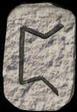
| The left rune represents the first possible outcome. Perth is the rune of chance and gambling. Throw the dice, read your fate. Gaming is a fine way to pass the night...as long as one is careful. Games of chance have outcomes that are hidden from us, and as such Perth represents secrets unknown. Perth symbolizes enjoyment and wild abandon, but be watchful, for Perth is also the rune of mystery and the outcomes unexpected. You cannot lose if you do not play, but neither can you win... |
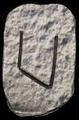
| The right rune represents the second possible outcome. Uruz is the name of the Auroch, an extinct prehistoric ox. This animal was strong and brave, and was the focus of rites of manhood in older days. Reversed, this rune symbolizes either the lack of challenge, or the lack of preparation for a challenge. This rune suggests that you must reach deep within in order to gain the power you will need, whether to get out of your current rut, or to face what appears to be a hopeless situation. |
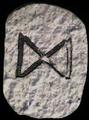
| The bottom rune represents the critical factor that determines what will come to pass. Dagez means daylight, and represents divine light. This rune generally refers to dawn (the initial sparking of energy) or to midday (the climax of energy). Both dawn and midday are symbolic of change, but unlike the changes in the perpetual circle of the year which are slow and subtle, the changes over a day are much faster and more dramatic. The breaking of a new day is symbolic of the rapid illumination of dismal circumstances, and is suggestive of Satori. Be careful - although this rune generally suggests a positive change, the symbology of a peaking point suggests that there must be a change downward as well. Fortunately for some, this rune is cyclic and irreversible, and so permanence is not promised - the only thing you can be sure of is an exciting ride. |
|
|