Today's Tarot for Adolf Hitler
| The Cross and Triangle spread is a powerful means of understanding complex situations, developed by the Hermetic Order of the Golden Dawn. This spread is rich in occult and mystical symbolism, and one of our favorites here at Facade. The William Blake Tarot explores the mystical vision and artistry of the renowned English painter and poet. Through rich interpretations focused on creative undertakings, it has long been the deck of choice for artists, writers, musicians, and thinkers. For more information about this deck, or to buy your own personal copy, go to www.blaketarot.com.
|
 | The first card, the significator, is placed in the center of the cross. This card represents the prime energy manifest in your life. Knowledge: An important, possibly moral choice to be made. Be discriminating with advice from others. Deep insight into a relationship or one's own involvement in a relationship. A need to integrate all levels of consciousness within oneself. An opportunity for intimacy and open communications. |
 | The second card, placed above the significator, represents Air. It describes your spirit, process of thought, and the influence of reason. Child of Painting, when reversed: Being carried astray by a wave of prosperity. Relying on your innate tendencies to the exclusion of acquired sense and skills. Inability to leave a position of material advantage. Hedonistic enjoyment. Drug experimentation. Surfing the Internet. Total absorption in your activities. Being ruled by your body and instincts. Obsession with new experiences. In the creative process: Now is a time to experiment with processes and materials, taking great pleasure in what you learn and create. |
 | The third card, placed to the right of the significator, represents Fire. It describes your motivations, creative energies, and the influence of passion. Three of Painting (Practice), when reversed: Failure to master your skills and talents. Lack of engagement with your peers. Unwillingness to synthesize the available factors. Failure to build support. In the creative process: Experimentation and manipulation are the keys to acquiring the experience needed to get the job done. |
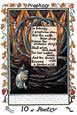
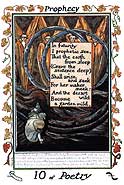 | The fourth card, placed below the significator, represents Water. It describes your emotions, meditations, and the influence of love. Ten of Poetry (Prophecy): "In futurity / I prophetic see / That the earth from sleep / (Grave the sentence deep) Shall arise and seek / For her maker meek: And the desart wild / Become a garden mild". Experiencing a feeling of spiritual elevation. Profound existential gratitude. Communion with elemental forces. Acceptance of divine will. Things are turning on the hinge of fate. Having the gift of prophecy, and speaking the truth. "Telling it like it is." Commitment to serve the greater good. Awakening to the larger implications of life. In the creative process: A time of divine grace in which you have special access to creativity. Be humble despite your achievements; you are channeling from a higher source. |
 | The fifth card, placed to the left of the significator represents Earth. It describes your physical presence, position in life, and the influence of the material world. Nature, when reversed: Overgrowth. Natural forces out of control. Fear of nature and sexuality. Mothering issues. Seduced by the illusions of materialism. |
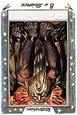
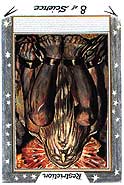 | At this point the cross is complete and the triangle is formed. The sixth card, placed on the bottom left of the triangle represents one of two opposing forces. Eight of Science (Restriction), when reversed: Suppressed creative energy waiting to burst free. External constraints provide much-needed focus. Intense mental fervor despite outward calm. Freedom from your prejudices, dogmatic attitudes, and fear of failure. Self discipline and mastery over ones emotions. In the creative process: Make your obstructions or limitations productive by stimulating greater intensity of thought and a deeper sense of spiritual freedom. |
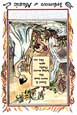
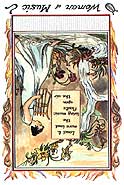 | The seventh card, placed on the bottom right of the triangle represents the force that opposes the bottom left card. These forces may be external, but they are frequently one's own inner archetypes in conflict. Woman of Music, when reversed: Obsession with the illusion of beauty, grace, and tranquility in your surroundings. Undue attention to the emotions and needs of people around you. False belief in your own talents and charm. Being haunted by loneliness and dreams. Inhibitions blocking your expression of ideas and feeling. Over-sensitivity to criticism. In the creative process: You vibrate in tune with everything around you, sensitively aware of life energy in all its forms, from which to create something new through the filter of your own consciousness. |
 | The eighth card, the reconciler, is placed below the cross in the third vertex of the triangle. This is the force that will resolve the conflict between the bottom left and bottom right cards. By meditating on this force and bringing more of it into your life, you can bring the matter at hand to a swifter conclusion than would naturally occur. Eight of Painting (Discipline): Proper pacing or management of your workload or time. Taking control of a difficult situation. Following the lead of a mentor or inner guide. A need for physical assessment and self-improvement. Seek appropriate education and training. Step-by-step progress. Diligence and perseverance. Tackling a mountain of work. In the creative process: Even though you may have a long way to go, a methodical approach incorporating guidance and training will ultimately lead you to the top. |
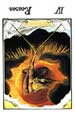
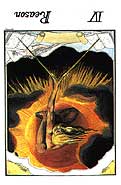 | The ninth and final card, placed in the center bottom of the triangle, represents the final outcome unless you change course. Reason, when reversed: Naked rationalism is in the driver's seat. Being out of touch with your heart and inner voice. Feeling bound by rules without context. Finding oneself trapped in a hierarchy, whether at the top or the bottom. Reliance on the patriarchal or traditional approach in the face of changing times or contexts. Fathering issues. Watch for ironies, as the emperor has no clothes. |
|
|