Today's Tarot for Antonio Banderas
| The Two Paths spread provides insight into an important decision ahead of you, the possible outcomes, and the forces that draw you towards each of these outcomes. The Rider Waite Tarot is the most widely recognized Tarot deck, and the first deck published in the 20th century. It was created by members of the Hermetic Order of the Golden Dawn, and is especially suited to questions of a mystical nature. If you would like your own copy of the Rider Waite Tarot, you can buy it now! |
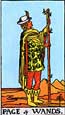
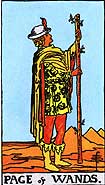 | The top left card represents the first possible outcome. Page of Wands: The essence of fire behaving as earth, such as wood or coal: The surprising appearance of a new passion. An adventurer who blazes through life, acting as a catalyst that others may harness. The intense enthusiasm and childlike imagination that fuels any new venture, needing only the application of mind and material to make it a success. Inner fire that can drive away fear and replace it with fury. Can represent a person of some timidity, but whose innate passion can be easily ignited. May indicate the birth of a child. |
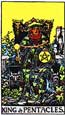
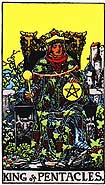 | The top right card represents the second possible outcome. King of Pentacles: The essence of earth behaving as air, such as a diamond: A true businessman, with a gift for identifying opportunities and taking advantage of them. A person well informed about the world, skilled in all things physical, and eager to encourage others. A pillar of practicality and dependability, embracing tried and tested methods, and possessing an innate understanding of the material reality. A philanthropist and devotee of both luxury and hard work, whose word is as good as gold. |
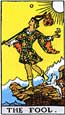
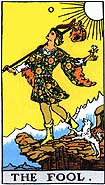 | The middle left card represents the force drawing you towards the first possible outcome. The Fool: Fearlessness, imagination, open-mindedness, and an adventurous spirit. Freedom from cares and worries. Ideas, thoughts, and impulses coming from a completely unexpected place. Nonchalance at the threshold of gaining all or losing all. Extravagance and intoxication with life. The pure and undifferentiated power of creation itself, where ultimate knowledge and oblivion are unified. |
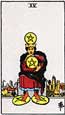
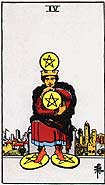 | The middle right card represents the force drawing you towards the second possible outcome. Four of Pentacles (Power): Cleaving to earthly power in the desperate fear that it will be lost. Making yourself an obstacle to progress due to lack of originality and a desperate fear of change. Believing that security and identity are based primarily on the possession of material things. Coveting things and people. Living in a cloud of suspicion and prejudice. |
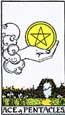
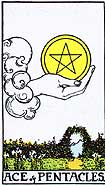 | The bottom card represents the critical factor that decides what will come to pass. Ace of Pentacles: The seed of prosperity and material gain - perhaps as yet unseen. A new foundation from which to turn your dreams into reality. The need to focus on the practical and understand the dynamics of the natural world. May represent a gift, document, inheritance, or an unexpected opportunity for physical achievement. |
|
|