Today's Tarot for Benjamin Franklin
| The Creative Process spread is designed specifically to peer into the nature of a project or creative undertaking, and shine a spotlight on the evolution of its parts. The William Blake Tarot explores the mystical vision and artistry of the renowned English painter and poet. Through rich interpretations focused on creative undertakings, it has long been the deck of choice for artists, writers, musicians, and thinkers. For more information about this deck, or to buy your own personal copy, go to www.blaketarot.com.
|
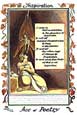
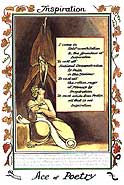 | The card in the middle represents the creative force behind the project, be it a person, organization, or other entity. Ace of Poetry (Inspiration): "I come in Self-annihilation & the grandeur of Inspiration / To cast of Rational Demonstration by Faith in the Saviour / To cast off the rotten rags of Memory by Inspiration / To cast aside from Poetry all that is not Inspiration". The kiss of divine inspiration. Receiving an impetus to creative action. Getting in touch with higher consciousness or Spirit. Experiencing a personal vision of truth, beauty, ecstasy. Discovering sexuality as a metaphor for imaginative experience. Sense of being guided by a higher force. The "Yes!" card. A soulful new beginning. In the creative process: Being in contact with the purest and highest part of your being provides the impetus for fresh expressions in both art and life. |
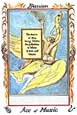
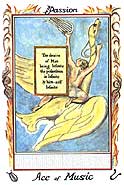 | The card on the top represents imagination - the prophetic image that stems from the creative force of the previous card to initiate the project. This is the poetry or voice of the undertaking. Ace of Music (Passion): "The desire of Man being Infinite the possession is Infinite & himself Infinite." Release of emotions. Upsurge of creative power. Unlimited potential. Being carried away by your emotions (swept up on wings of song). Feeling a passion for life. Wanting to achieve the highest potentials in yourself and the situation. Following your bliss. Feeling a deep sense of grace and fulfillment. Vulnerability and openness. In the creative process: A passionate desire to rise above the norm, to soar to personal new heights of creative vision. |
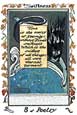
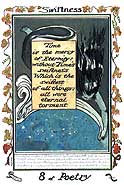 | The card on the left represents emotion - the feelings aroused by or surrounding the ideation of the project that takes place in the previous card. This is the music or scent of the undertaking. Eight of Poetry (Swiftness): "Time is the mercy of Eternity: / without Time's swiftness Which is the swiftest of all things: / all were eternal torment". Vigorous and imaginative assertion is strongly indicated. Experiencing the relativity of time. The speeding-up of events or gathering of energy. Falling in love, or being swept off your feet. Everything is up in the air or in process. Flux. Rapid communications across time and space. The Internet. Look for coincidences and serendipity at work. In the creative process: Transcend all illusions of time and space by using your imagination, which can take you anywhere at any time. |
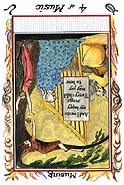 | The card on the bottom represents thought - the analytical process of organizing the project and capturing the emotional content of the previous card. This is the science or vision of the undertaking. Four of Music (Musing), when reversed: Letting your mind wander at critical times. Mixing business with pleasure to your detriment. Being unaware of what is going on around you. Feeling lethargic, lazy, or apathetic. In the creative process: Relax into playfulness, whimsically experiment with improvisation or reminiscence about past experiences. Such meditations alleviate stress and refresh the imagination. Make space for the gifts of spirit to move through you. |
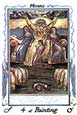
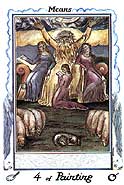 | The card on the right represents manifestation - the real work involved in completing the project, and the form it will take upon culmination. This is the painting or touch of the undertaking. Four of Painting (Means): Material prosperity and contentment. Creative achievements using material resources. Consolidation of personnel and materials. Bringing about order and structure. Emphasis on controlling, dominating, or monopolizing. Protecting and maintaining. In the creative process: Before reaching out for creative inspiration, prepare the groundwork: by appropriately allocating your resources and assigning creative tasks. |
|
|