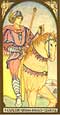
Today's Tarot for Chuck Yeager
| The Fourfold Vision spread offers a progression of different ways of looking at an object, person, or situation. It is a powerful tool for gaining deeper insight into the specific subjects of other readings. The Renaissance Tarot is a modern deck, with symbolism drawn from the heroic age and rendered in renaissance style. This deck is an excellent choice for exploring questions of passion, mastery, and the inner workings of human reason. If you would like your own copy of the Renaissance Tarot, you can buy it now! |
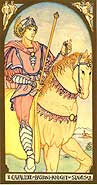 | The card on the far right represents the object being viewed, be it an idea, relationship, or the self. Knight of Staves: A traveler. A journey. The call of far away places. The arrival or return of a pilgrim or wanderer. A person of far-ranging interests and restless curiosity who is desirous of change and transformation. Inventive and artistic, but sometimes absent-minded person. Having one's "head in the clouds." |
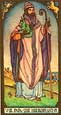
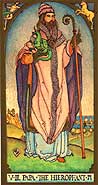 | The card second from the right represents the physical vision: how the object is seen at a base or mechanical level. The Hierophant: The abstract, spiritual and intellectual side of the animus, or masculine nature of the soul. Spiritual authority. Religious tradition. Avuncular wisdom. The old order and the old school. |
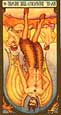
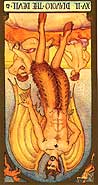 | The card in the middle represents the mental vision: the object personified and seen through a humanized perspective. The Devil, when reversed: Irresponsible pleasures. Prankishness. Childish panic. Undignified behavior. Fare baccano, to "paint the town." |
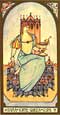
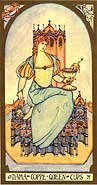 | The card second from the left represents the emotional vision: how passions and values are creatively stimulated by the mental vision. Queen of Cups: A person of generous and loving nature, graceful and sparkling as a mountain stream, or deep and serene as a country lake. A poetess, musician or actress. |
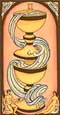
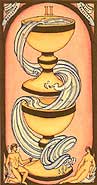 | The card on the far left represents the fourfold or mystical vision: still viewing through the previous three, we now add a spiritual element, revealing unseen aspects of the object. Two of Cups (Love): The flower of first love, of love at first sight. The bond between two people, invisible but formidable. |
|
|