Today's Tarot for Freddie Prinze Jr.
| The Two Paths spread provides insight into an important decision ahead of you, the possible outcomes, and the forces that draw you towards each of these outcomes. The Voodoo Tarot of New Orleans is a deck rich in primal spirituality. It draws on images from the religion Santeria, which weaves Catholic and African beliefs into a vibrant tapestry. This exceptional deck is most often used to ask questions regarding the joy, fury, and spirituality in everyday life. If you would like your own copy of the Voodoo Tarot of New Orleans, you can buy it now! |
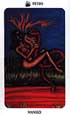
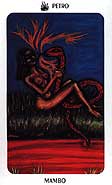 | The top left card represents the first possible outcome. Petro Mambo (Queen of Wands): The essence of fire behaving as water, such as a rainbow: The natural embodiment of passion and sensuality, who is always the center of attention. One who reflects the desires and ambitions of others, and ignites them. A radiantly vital person, cocky and charismatic, who sees what she wants and goes after it. |
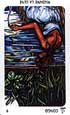
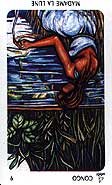 | The top right card represents the second possible outcome. Madame La Lune (Nine of Cups), when reversed: Vanity, conceit, and smugness in romance, friendship, or other relationships. Achieving what you always thought you wanted. Overindulging in food, drink, or the pleasures of the flesh. A state of joy and abundance that is shallow and fleeting. |
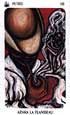
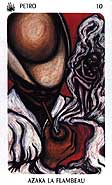 | The middle left card represents the force drawing you towards the first possible outcome. Azaka La Flambeau (Ten of Wands): Success and gain, leading you to take on a burden greater than you can carry. Noble leadership transformed, through lack of restraint, into tyranny. The crushing weight of ultimate responsibility. Having spent their fuel, the engines of creation grind to a halt. |
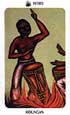
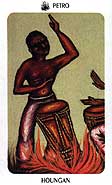 | The middle right card represents the force drawing you towards the second possible outcome. Petro Houngan (King of Wands): The essence of fire behaving as air, such as lightning: A great and daring leader who inspires others to rise to challenges alongside him. An artist who can take hold of an idea and make it a reality through bold action. One who is forceful, charismatic, and honest, leading by example, but unafraid to invest authority in others. A dashing and magnetic personality, carrying authority naturally, and striking at the world with swiftness and grace. |
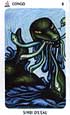
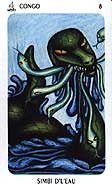 | The bottom card represents the critical factor that decides what will come to pass. Simbi d'l'eau (Eight of Cups): Losing interest in a matter deeply important to you. Being forced to abandon something in which you had invested great love and devotion. Seeking earthly, physical pleasures, to the exclusion of spiritual growth and emotional fulfillment. Emotional withdrawal and lethargy. |
|
|