Today's Tarot for J.K. Rowling
| The Fourfold Vision spread offers a progression of different ways of looking at an object, person, or situation. It is a powerful tool for gaining deeper insight into the specific subjects of other readings. The William Blake Tarot explores the mystical vision and artistry of the renowned English painter and poet. Through rich interpretations focused on creative undertakings, it has long been the deck of choice for artists, writers, musicians, and thinkers. For more information about this deck, or to buy your own personal copy, go to www.blaketarot.com.
|
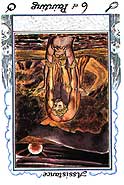 | The card on the far right represents the object being viewed, be it an idea, relationship, or the self. Six of Painting (Assistance), when reversed: Reliance on favors or tangible help of some kind. Restrictive influences from sponsorship or patronage. A negative influence in the situation. Being "kept". The illusion of generosity. Charity with strings attached. Taking advantage of those in need. In the creative process: You can attract the assistance and tools you need by using your imagination and not giving up hope. |
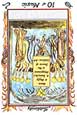
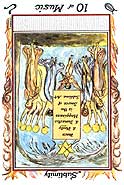 | The card second from the right represents the physical vision: how the object is seen at a base or mechanical level. Ten of Music (Sublimity), when reversed: Gifts of love withheld, especially in relationship or marriage. Hiding your deepest feelings from others. Subtle barriers to friendship and social involvements. Failure to recognize achievement. A dull tinge to the happiness of hearth, home, and hospitality. Slight lack of fulfillment in communal or community involvement. In the creative process: Combine your efforts with others to create a unified whole greater than the sum of its parts. |
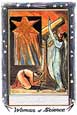
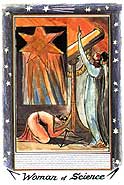 | The card in the middle represents the mental vision: the object personified and seen through a humanized perspective. Woman of Science: Seeking out pertinent data. Methodical approach to a problem. Looking within yourself for answers. Upholding truth. Counseling others. Forming opinions based on observation and deduction. Weighing abstract ideas. Avoiding personal involvement. Demonstrating principles. Self-discipline. Be cautious of becoming opinionated or over-professional. In the creative process: Now is the time to research and gather information, get an overview, and make long-range plans and strategies. |
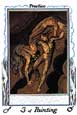
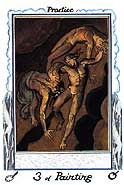 | The card second from the left represents the emotional vision: how passions and values are creatively stimulated by the mental vision. Three of Painting (Practice): A need to exercise and master your skills and talents. Creatively interacting with your peers. The play of social dynamics at work or on the job. Seeking a synthesis of the available factors. Building support. Integrating energies to achieve a mutual goal. In the creative process: Experimentation and manipulation are the keys to acquiring the experience needed to get the job done. |
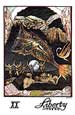
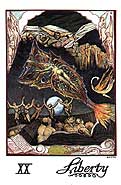 | The card on the far left represents the fourfold or mystical vision: still viewing through the previous three, we now add a spiritual element, revealing unseen aspects of the object. Liberty: An emerging and powerful sense of personal freedom. Hearing a call to action. Awakening to a deeper level of awareness or sense of spiritual self. A rebirth or basic change of state. Making an important decision or judgment, perhaps one long delayed. Being released from limiting circumstances. |
|
|