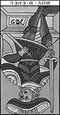
| The Celtic Cross spread is one of the most popular Tarot spreads, providing varied insight into many aspects of a complex situation and your role in it. The Marseilles Tarot is an 18th century creation of obscure origins. It predates the occult symbolism of the Rider Waite deck by roughly 200 years, giving the readings a unique and rustic flavor. Many swear by this deck as the true oracle of the common man. If you would like your own copy of the Marseilles Tarot, you can buy it now! |
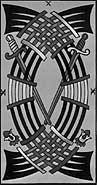 | The card not shown but at the center of the cross, represents the atmosphere surrounding the central issue. Ten of Swords (Ruin), when reversed: The darkness before the dawn. An end to suffering, leading to spiritual transformation. A crushing and seemingly total defeat that hides within it the seeds of final victory. Ultimate knowledge gained through ultimate sacrifice. |
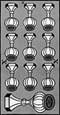
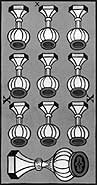 | The card visible at the center of the cross represents the obstacle that stands in your way - it may even be something that sounds good but is not actually to your benefit. Ten of Cups (Satiety), when reversed: Dissipation, debauchery, and stagnation. Taking one's good fortune for granted. Problems in domestic and social matters. A false love or infatuation, leading to a lack of fulfillment. |
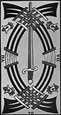
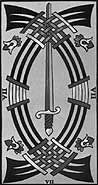 | The card at the top of the cross represents your goal, or the best you can achieve without a dramatic change of priorities. Seven of Swords (Futility): An opportunity to withdraw from a hopeless situation and fight another day. Disengagement from a struggle you should never have been involved in. A desperate attempt to resolve a matter without conflict. The use of cleverness or outright deception to turn the tide in your favor. |
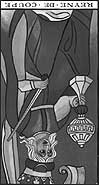 | The card at the bottom of the cross represents the foundation on which the situation is based. Reyne de Coupe (Queen of Cups), when reversed: The dark essence of water, such as a deep and foreboding lake: Discomfort with the worlds of mind and matter, leading to a retreat to the spiritual. The embrace of negative relationships, driven by the desperate fear of being alone. Devotion to fantasies and daydreams, to the exclusion of practical skills or the pursuit of knowledge. Insecurity leading to dishonor, vice, and undue susceptibility to outside influences. |
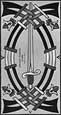
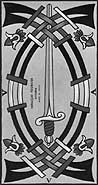 | The card at the left of the cross represents a passing influence or something to be released. Five of Swords (Defeat): A success earned through personal degradation. Separation from friends brought about by an unfeeling and coldly calculated act. Temporary victory tainted by dishonor and providing fuel for eventual defeat. |
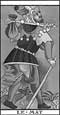
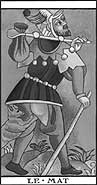 | The card at the right of the cross represents an approaching influence or something to be embraced. Le Mat (The Fool): Fearlessness, imagination, open-mindedness, and an adventurous spirit. Freedom from cares and worries. Ideas, thoughts, and impulses coming from a completely unexpected place. Nonchalance at the threshold of gaining all or losing all. Extravagance and intoxication with life. The pure and undifferentiated power of creation itself, where ultimate knowledge and oblivion are unified. |
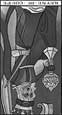
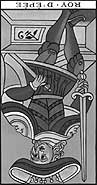 | The card at the base of the staff represents your role or attitude. Roy d'Epee (King of Swords), when reversed: The dark essence of air, such as a gray sky: A mature leader of unyielding ethics and absolute authority. An incorruptible judge, whose devotion to the letter of the law cannot be swayed by emotion, mercy, or exigent circumstances. Perfect clarity of thought, excessive use of force, and mastery of language as a tool for deception. One who, like a great tyrant, inspires not love or devotion, but fear, respect, and obedience. |
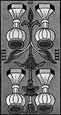
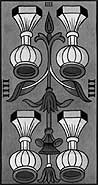 | The card second from the bottom of the staff represents your environment and the people you are interacting with. Four of Cups (Luxury), when reversed: New and unusual relationships and opportunities. The reawakening of your appetite for life or love. The path of excess leading to spiritual rejuvenation and the appearance of novel ambitions. |
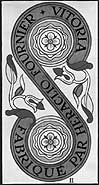 | The card second from the top of the staff represents your hopes, fears, or an unexpected element that will come into play. Two of Coins (Change): Balance and harmony achieved in a time of upheaval and transformation. Taking two steps forward for every one step back. Shifting the importance of projects and priorities to keep everything on track. A change in occupation or location. |
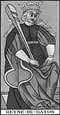
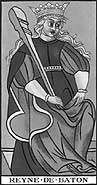 | The card at the top of the staff represents the ultimate outcome should you continue on this course. Reyne de Baton (Queen of Batons): The essence of fire behaving as water, such as a rainbow: The natural embodiment of passion and sensuality, who is always the center of attention. One who reflects the desires and ambitions of others, and ignites them. A radiantly vital person, cocky and charismatic, who sees what she wants and goes after it. |