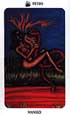
Today's Tarot for Laurence Olivier
| The Creative Process spread is designed specifically to peer into the nature of a project or creative undertaking, and shine a spotlight on the evolution of its parts. The Voodoo Tarot of New Orleans is a deck rich in primal spirituality. It draws on images from the religion Santeria, which weaves Catholic and African beliefs into a vibrant tapestry. This exceptional deck is most often used to ask questions regarding the joy, fury, and spirituality in everyday life. If you would like your own copy of the Voodoo Tarot of New Orleans, you can buy it now! |
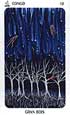
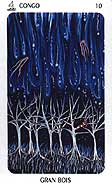 | The card in the middle represents the creative force behind the project, be it a person, organization, or other entity. Gran Bois (Ten of Cups): Fulfillment and joy in life and love. Feeling peace, tranquility, and contentment in friends and family. Taking delight in one's good fortune. |
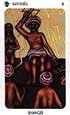
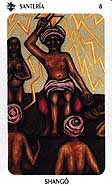 | The card on the top represents imagination - the prophetic image that stems from the creative force of the previous card to initiate the project. This is the poetry or voice of the undertaking. Shango (Eight of Discs): Dedicating yourself fully to a task. Learning a new craft or skill. Applying painstaking attention to detail. Industriousness and the efficient completion of tasks. Sticking with a project long enough to see it through. |
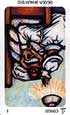
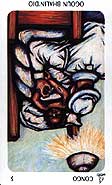 | The card on the left represents emotion - the feelings aroused by or surrounding the ideation of the project that takes place in the previous card. This is the music or scent of the undertaking. Ogoun Bhalin'dio (Five of Cups), when reversed: Accepting a loss. Overcoming sadness and grief to get on with your life. Realizing the value of what you still have. Dissatisfaction gives way to a new hope and understanding. May allude to a broken relationship or tragedy. May also refer to a gift, inheritance, opportunity, partnership, or marriage that has fallen below expectations. |
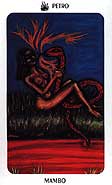 | The card on the bottom represents thought - the analytical process of organizing the project and capturing the emotional content of the previous card. This is the science or vision of the undertaking. Petro Mambo (Queen of Wands): The essence of fire behaving as water, such as a rainbow: The natural embodiment of passion and sensuality, who is always the center of attention. One who reflects the desires and ambitions of others, and ignites them. A radiantly vital person, cocky and charismatic, who sees what she wants and goes after it. |
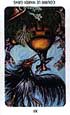
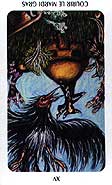 | The card on the right represents manifestation - the real work involved in completing the project, and the form it will take upon culmination. This is the painting or touch of the undertaking. Courir Le Mardi Gras (The Devil), when reversed: Resistance of temptation. Freedom from bondage. The pursuit of higher goals despite the influence of luxury and pleasure. Release from obsession with money and power. Liberation from fear, weakness and indecision through communion with higher powers or the inner voice. |
|
|