Today's Tarot for Sean Connery
| The Fourfold Vision spread offers a progression of different ways of looking at an object, person, or situation. It is a powerful tool for gaining deeper insight into the specific subjects of other readings. The Sola Busca Tarot is a color embellished reproduction of the only known extant 15th century Tarot deck engraved on metal. It is the choice of purists and those seeking a direct channel with the dawn of Western occultism. |
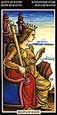
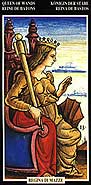 | The card on the far right represents the object being viewed, be it an idea, relationship, or the self. Regina di Mazze (Queen of Wands): The essence of fire behaving as water, such as a rainbow: The natural embodiment of passion and sensuality, who is always the center of attention. One who reflects the desires and ambitions of others, and ignites them. A radiantly vital person, cocky and charismatic, who sees what she wants and goes after it. |
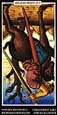
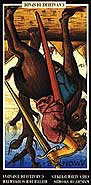 | The card second from the right represents the physical vision: how the object is seen at a base or mechanical level. Cavaliere di Spade (Knight of Swords), when reversed: The dark essence of air behaving as fire, such as a tornado: A merciless and skillful warrior, unfettered by emotion or conscience. A nihilist who can refuse not even the most insurmountable of challenges. A person who inspires fear and hate through their domineering nature and the power of their presence. Speaking without tact or tolerance, in a sarcastic manner. May portend the swift initiation or conclusion of conflict, through the calamitous invocation of force. |
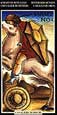
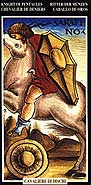 | The card in the middle represents the mental vision: the object personified and seen through a humanized perspective. Cavaliere di Dischi (Knight of Discs): The essence of earth behaving as fire, such as molten magma: One slow to action, but decisive and unrelenting once set in motion. A force of nature whose methods are as predictable and dependable as they are unstoppable. The voice of duty, honor, and responsibility. The will to the change the world, not through bold action, but through the thorough and unwavering application of proven means. |
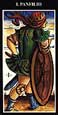
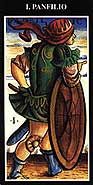 | The card second from the left represents the emotional vision: how passions and values are creatively stimulated by the mental vision. Panfilio (The Magician): Mastery over word, mind, and matter. The ability to turn ideas into actions, handle problems, and control one's life. The initiation of new projects, great works, or a new way of life. Eloquent and moving communication. Arcane and eldritch technologies. |
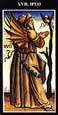
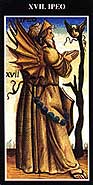 | The card on the far left represents the fourfold or mystical vision: still viewing through the previous three, we now add a spiritual element, revealing unseen aspects of the object. Ipeo (The Star): New hopes and splendid revelations of the future. Insight, inspiration, courage and enlightenment of the spiritual self. Body and mind and converging towards the light at the end of a dark time. |
|
|