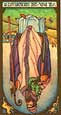
Today's Tarot for Wes Craven
| The Cross and Triangle spread is a powerful means of understanding complex situations, developed by the Hermetic Order of the Golden Dawn. This spread is rich in occult and mystical symbolism, and one of our favorites here at Facade. The Renaissance Tarot is a modern deck, with symbolism drawn from the heroic age and rendered in renaissance style. This deck is an excellent choice for exploring questions of passion, mastery, and the inner workings of human reason. If you would like your own copy of the Renaissance Tarot, you can buy it now! |
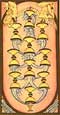
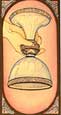
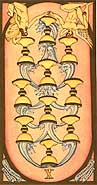 | The first card, the significator, is placed in the center of the cross. This card represents the prime energy manifest in your life. Ten of Cups (Satiety), when reversed: Emotional turbulence. Unrequited love. Family disagreements. |
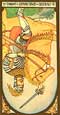
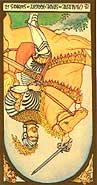 | The second card, placed above the significator, represents Air. It describes your spirit, process of thought, and the influence of reason. Knight of Swords, when reversed: Opinionated person who is too quick to condemn others. Bigotry. Action without forethought. |
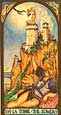
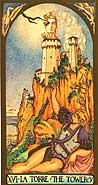 | The third card, placed to the right of the significator, represents Fire. It describes your motivations, creative energies, and the influence of passion. The Tower: Comeuppance. Setback. Disaster. Arrogance of pride cast down by Providence. Unforeseen event. Calamity. |
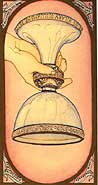 | The fourth card, placed below the significator, represents Water. It describes your emotions, meditations, and the influence of love. Ace of Cups, when reversed: Love unsatisfied or unrequited. Love trickling away, eroded by time, thoughtlessness and selfishness. |
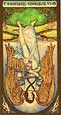
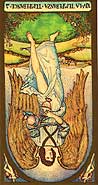 | The fifth card, placed to the left of the significator represents Earth. It describes your physical presence, position in life, and the influence of the material world. Temperance, when reversed: Excess. Imbalance. Indulgence. Polarization. |
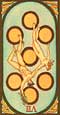
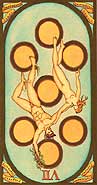 | At this point the cross is complete and the triangle is formed. The sixth card, placed on the bottom left of the triangle represents one of two opposing forces. Seven of Coins (Assessment), when reversed: Unwise decision. Stagnation. |
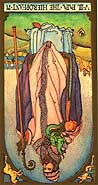 | The seventh card, placed on the bottom right of the triangle represents the force that opposes the bottom left card. These forces may be external, but they are frequently one's own inner archetypes in conflict. The Hierophant, when reversed: Dogmatic beliefs. Spiritual authoritarianism. Enfeebled philosophizing. |
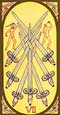
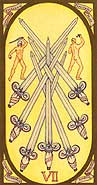 | The eighth card, the reconciler, is placed below the cross in the third vertex of the triangle. This is the force that will resolve the conflict between the bottom left and bottom right cards. By meditating on this force and bringing more of it into your life, you can bring the matter at hand to a swifter conclusion than would naturally occur. Seven of Swords (Futility): Favorable turn of events. Hope for sustained success. Vigilance and strength. |
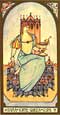
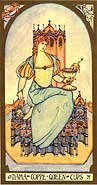 | The ninth and final card, placed in the center bottom of the triangle, represents the final outcome unless you change course. Queen of Cups: A person of generous and loving nature, graceful and sparkling as a mountain stream, or deep and serene as a country lake. A poetess, musician or actress. |
|
|