| The Relationship spread provides insight into the interaction between two people or entities. It is the spread of choice for questions about partnerships, be they in romance or business. The images of the Minchiate Tarot are drawn from a rare surviving 18th century deck of 97 cards - 19 more than the traditional Tarot. It is considered by many to be the single most powerful divination tool on the web, providing deep insight, rich in ancient symbolism, to any question you may pose. If you would like your own copy of the Minchiate Tarot, you can buy it now!
|
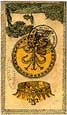
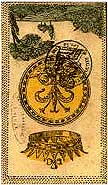 | The card at the top left represents how you see yourself. Ace of Coins, when reversed: The seed of luxury, debauchery, and physical gratification. The seductions of the material world draw you away from an opportunity for stability and comfort. The need to focus on the practical and understand the dynamics of your environment. May represent a gift, document, inheritance, or physical event. |
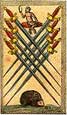
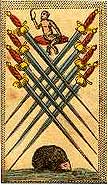 | The card at the top right represents how you see your partner. Eight of Swords (Interference): Chagrin at the unforeseen consequences of prior decisions. Criticism, censure, and the imposition of external restrictions. Confusion leading to powerlessness. Inability to focus on the crux of a problem and free oneself from a difficult situation. Being hamstrung by a past failure or humiliation. |
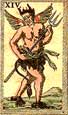
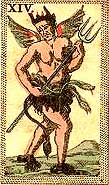 | The card in the center left represents how you feel about your partner. The Devil: Being seduced by the material world and physical pleasures. Lust for and obsession with money and power. Living in fear, domination and bondage. Being caged by an overabundance of luxury. Discretion should be used in personal and business matters. |
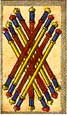
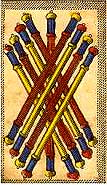 | The card in the center right represents what stands between you and your partner. Nine of Wands (Strength), when reversed: Delayed preparations for an impending trial. Efforts compromised by traitors or saboteurs. The scattering of forces before the conclusive battle is fought. Ill health and faltering of the will. |
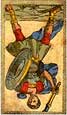
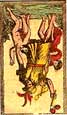
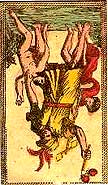 | The card in the lower left represents how your partner sees you. The Fool, when reversed: Apathy, negligence, and dangerous carelessness. Unquenchable wanderlust. Obsession with someone or something. Losing all sense of proportion. Foolhardy adventuring and lack of interest in critical matters. Immature or unrealistic ideals. Strange impulses and desires coming from unexpected sources. Vanity, delirium, folly, and oblivion. |
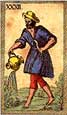
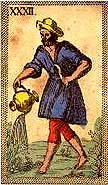 | The card in the lower right represents what your partner feels about you. Aquarius: A friendly humanitarian, honest and loyal to a fault. A perceptive communicator with strong intuitions about human nature. Independence and intellectual inventiveness, coupled with a drive towards the eccentric. |
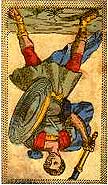 | The card in the center represents the present status or challenge of the relationship. Page of Wands, when reversed: The dark essence of fire behaving as earth, such as dry wood: The surprising appearance of a new passion or inflammatory news. A trickster who can unexpectedly ignite a dangerous situation. The intensity and childish imagination that can send even the most stable venture spinning wildly out of control. Can represent a person outwardly timid, but harboring unexpected inner fury. May indicate the birth of a child. |