Today's Runes for Neal Stephenson
| The Cross spread is used to plot the arc of your life and the forces acting on it. It is the most popular spread, giving a very complete view of the situation. Gold Runes are most commonly used for questions about business, career, and property. |
| The left rune represents an important element of the past. Tyr was the Norse god of war. It was through his sacrifice that the great force of chaos, the wolf Fenrir was bound. Here however, you have drawn the rune reversed. This could mean that a sacrifice made will not lead to the desired result. It could also mean a loss, or a victory overturned. This rune warns against entering into conflicts or negotiations, especially ones requiring that an offering or concession be made - the wolf might take your hand and yet remain unbound. Note also that Tyr was the god of law, so there is a suggestion of a wrongdoer who will avoid justice. |
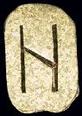
| The middle rune represents a deciding element of the present. Hagalaz is the rune of hail. Hail is a destructive and elemental force, so one can expect this rune to represent the disruption of one's life. In the harsh northern winter there is a halt to activity, and so delay or hindrance is frequently associated with this rune. The opposite of chaos is yet more chaos, as illustrated by the fact that this rune cannot be reversed. |
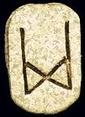
| The top rune represents a force that works for you. Man refers to Mankind and your interaction with the whole of human population. This rune is reversed, suggesting a separation from your fellow man. There is a lack of harmony in your interaction with others, either because you do not accept society or society does not accept you. Alternatively, this rune may also represent your separation from nature, and your ability to rise above the base level of being. As the rune is reversed, this may suggest an incomplete level of spiritual attainment or an intellectual block. |
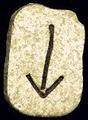
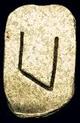
| The bottom Rune represents a force that works against you. Uruz is the name of the Auroch, an extinct prehistoric ox. This animal was strong and brave, and was the focus of rites of manhood in older days. Reversed, this rune symbolizes either the lack of challenge, or the lack of preparation for a challenge. This rune suggests that you must reach deep within in order to gain the power you will need, whether to get out of your current rut, or to face what appears to be a hopeless situation. |
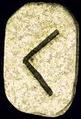
| The right rune represents the critical element of the future, at the core of the final outcome. Ken is the rune of light and knowledge, driving away darkness and ignorance and revealing hidden truth. This rune also brings forth images of friendship and comfort. Ken is the light of inspiration, the light of imagination, and a beacon in the darkest hours. |
|
|