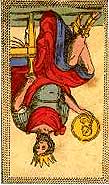
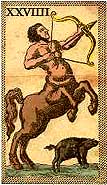
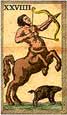
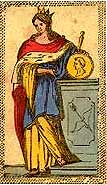
| The Celtic Cross spread is one of the most popular Tarot spreads, providing varied insight into many aspects of a complex situation and your role in it. The Palladini Tarot was created to "bridge the ancient and the future", using elements of Medieval, Egyptian and modern art. It is one of the most popular decks among new students of Tarot. If you would like your own copy of the Palladini Tarot, you can buy it now! |
 | The card not shown but at the center of the cross, represents the atmosphere surrounding the central issue. King of Pentacles, when reversed: The dark essence of earth behaving as air, such as a diamond: An unyielding businessman, with a gift for identifying weakness and exploiting it for personal gain. One well informed about material affairs, but ignorant of larger, more pressing issues. A blind devotee of business as usual, unconcerned with the unintended results, and contemptuous of new ideas. A person full of greed and avarice, easily corrupted by luxury or the temptations of the flesh. |
 | The card visible at the center of the cross represents the obstacle that stands in your way - it may even be something that sounds good but is not actually to your benefit. Seven of Rods (Valor): Standing courageously for your beliefs in the face of adversity. Fear of failure overcome by the will to succeed. Great obstacles met with heroism and determination. Inner strength brought to bear at a critical moment. |
 | The card at the top of the cross represents your goal, or the best you can achieve without a dramatic change of priorities. Five of Swords (Defeat), when reversed: Refusing to achieve success through personal degradation. Friendship maintained through the abandonment of a dishonorable gain. Slander and infamy avoided. |
 | The card at the bottom of the cross represents the foundation on which the situation is based. Three of Swords (Sorrow), when reversed: Unsettling news that helps you to distance yourself from a destructive relationship. Painfully honest communication that needs to take place. Not letting yourself be dragged by your emotions into a negative situation. A trust or confidence betrayed in an attempt to help someone in need. The revelation of a painful truth. |
 | The card at the left of the cross represents a passing influence or something to be released. Ace of Swords: The seed of victory - perhaps as yet unseen. A challenge to be met and solved through the invocation of force. An opportunity to bring reason and intelligence to bear in the pursuit of justice and truth. An excessive power that must not be abused. May suggest new ideas or information that can reveal a solution to the problem at hand. |
 | The card at the right of the cross represents an approaching influence or something to be embraced. Six of Pentacles (Success), when reversed: Insolence and conceit with material things. Overconfidence, bad investments, and imprudent handing of acquired wealth. Contempt for those less fortunate. Deception and petty disputes driven by greed and envy. |
 | The card at the base of the staff represents your role or attitude. The Magician: Mastery over word, mind, and matter. The ability to turn ideas into actions, handle problems, and control one's life. The initiation of new projects, great works, or a new way of life. Eloquent and moving communication. Arcane and eldritch technologies. |
 | The card second from the bottom of the staff represents your environment and the people you are interacting with. The High Priestess: A pure, exalted and gracious influence. Education, knowledge, wisdom, and esoteric teachings. The forces of nature. Intuition, foresight, and spiritual revelation of the most mysterious and arcane sort. |
 | The card second from the top of the staff represents your hopes, fears, or an unexpected element that will come into play. Knight of Pentacles, when reversed: The essence of earth behaving as fire, such as molten magma: One slow to action, even in the most urgent circumstances. A force of nature that cannot be diverted from the wrong path. The voice of duty and honor utterly divorced from reality. Lack of imagination and the complete unwillingness to try a different approach, even if the face of complete failure. Idleness and stagnation. |
 | The card at the top of the staff represents the ultimate outcome should you continue on this course. Eight of Swords (Interference), when reversed: Learning a valuable lesson from the unexpected consequences of prior decisions. Narrowly escaping criticism, censure, and the imposition of external restrictions. Focusing on the crux of a problem and freeing oneself from a difficult situation. Coming to grips with a past failure or humiliation and moving on. |