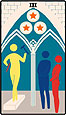
| The Twisting Path spread provides insight into the path ahead of you and the choices you must make. This is the spread for situations where more than one pitfall may lie ahead. The International Icon Tarot renders traditional occult symbolism in Swiss iconography. It is a humorous and direct approach to divination, and one of our favorite new decks. If you would like your own copy of the International Icon Tarot, you can buy it now!
|
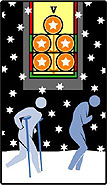 | The card at the lower left, represents the first decision along your path. Five of Pentacles (Worry): Hard times brought on by addiction, wasteful spending, ill health, or an outside event. Rejection, loneliness, and the need for comfort. May suggest unemployment, a catastrophe in personal finance, or a turn for the worse in business. |
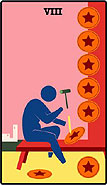 | The card to the far left represents the first false path that may lead you astray. Eight of Pentacles (Prudence): Dedicating yourself fully to a task. Learning a new craft or skill. Applying painstaking attention to detail. Industriousness and the efficient completion of tasks. Sticking with a project long enough to see it through. |
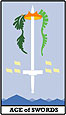
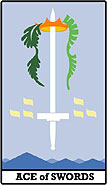 | The card in the middle represents the second decision along your path. Ace of Swords: The seed of victory - perhaps as yet unseen. A challenge to be met and solved through the invocation of force. An opportunity to bring reason and intelligence to bear in the pursuit of justice and truth. An excessive power that must not be abused. May suggest new ideas or information that can reveal a solution to the problem at hand. |
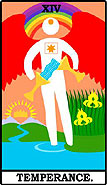 | The card at the lower right represents the second false path that may lead you astray. Temperance: Calm and restraint. Self-control, patience and tact in handling situations. The act of applying balanced spiritual and psychic forces to physical life. |
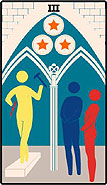 | The card at the top represents one possible mask of your true destination. Three of Pentacles (Works): The commencement of business, commercial transactions, or employment. The constructive use of creative talents, and the expression of artistry in workmanship. Skill and labor turned to the crafting of things of value. Using the conventional as a medium for expressing the exceptional, in order to build something of great renown and glory. |