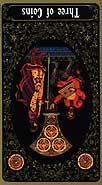
| The Celtic Cross spread is one of the most popular Tarot spreads, providing varied insight into many aspects of a complex situation and your role in it. The Marseilles Tarot is an 18th century creation of obscure origins. It predates the occult symbolism of the Rider Waite deck by roughly 200 years, giving the readings a unique and rustic flavor. Many swear by this deck as the true oracle of the common man. If you would like your own copy of the Marseilles Tarot, you can buy it now! |
 | The card not shown but at the center of the cross, represents the atmosphere surrounding the central issue. Valet de Deniers (Page of Coins), when reversed: The dark essence of earth, such as a chasm: Unfavorable news about business, finance, or the physical world. One who delights in all forms of luxury and physical excess, leaving practical matters unattended. Irrationality and failure to recognize obvious facts, coupled with a poor work ethic. Wastefulness, lack of focus, and loss. May portend the loss of a job or promotion. |
 | The card visible at the center of the cross represents the obstacle that stands in your way - it may even be something that sounds good but is not actually to your benefit. Seven of Coins (Assessment), when reversed: Labors abandoned before completion. Impatience, lack of effort, and the wasting of time. Idle and unprofitable speculation. |
 | The card at the top of the cross represents your goal, or the best you can achieve without a dramatic change of priorities. Three of Batons (Virtue), when reversed: Pride and arrogance. Convincing oneself that the ends justify the means. A great act of betrayal set in motion. Sinking to the level of an opponent. The vain quest for glory and a personal spotlight. Charity or friendship offered with intent of material gain. |
 | The card at the bottom of the cross represents the foundation on which the situation is based. Cavalier de Coupe (Knight of Cups), when reversed: The dark essence of water behaving as fire, such as a flash flood: Deceptive charm in the service of intense insecurity and rapidly shifting moods. Selfishness, indolence, and a complete lack of maturity. Misguided idealism divorced from practicality. Destructive romantic passions and infidelity. |
 | The card at the left of the cross represents a passing influence or something to be released. Roy de Deniers (King of Coins): The essence of earth behaving as air, such as a diamond: A true businessman, with a gift for identifying opportunities and taking advantage of them. A person well informed about the world, skilled in all things physical, and eager to encourage others. A pillar of practicality and dependability, embracing tried and tested methods, and possessing an innate understanding of the material reality. A philanthropist and devotee of both luxury and hard work, whose word is as good as gold. |
 | The card at the right of the cross represents an approaching influence or something to be embraced. Valet de Coupe (Page of Cups), when reversed: The dark essence of water behaving as earth, such as a wellspring: An unexpected new relationship that is childish and foolish. An idle dreamer oblivious to the realities of the world. Moodiness, sad reflection, and retreat from society. Seduction and deception in personal and business relationships. |
 | The card at the base of the staff represents your role or attitude. Five of Batons (Strife): An intense struggle motivated purely by the love of competition. A state of seeming chaos driven by endless small disputes and complications. A hotly contested race, debate, game, or other challenge. A stressful situation that brings out the best in the participants. |
 | The card second from the bottom of the staff represents your environment and the people you are interacting with. Nine of Batons (Strength): A pause in the current struggle to ready oneself. Preparation to meet the final conclusive onslaught. Forces assembled in anticipation of trials and tribulations. The steeling of the will to stand or fall. A line drawn in the sand. |
 | The card second from the top of the staff represents your hopes, fears, or an unexpected element that will come into play. Four of Coins (Power): Cleaving to earthly power in the desperate fear that it will be lost. Making yourself an obstacle to progress due to lack of originality and a desperate fear of change. Believing that security and identity are based primarily on the possession of material things. Coveting things and people. Living in a cloud of suspicion and prejudice. |
 | The card at the top of the staff represents the ultimate outcome should you continue on this course. Two of Coins (Change), when reversed: Imbalance and disharmony as a result of upheaval and transformation. Taking one step forward for every two steps back. Chaos caused by the shifting importance of projects and priorities. Industrious yet unreliable actions. Furious activity producing negligible results. |